

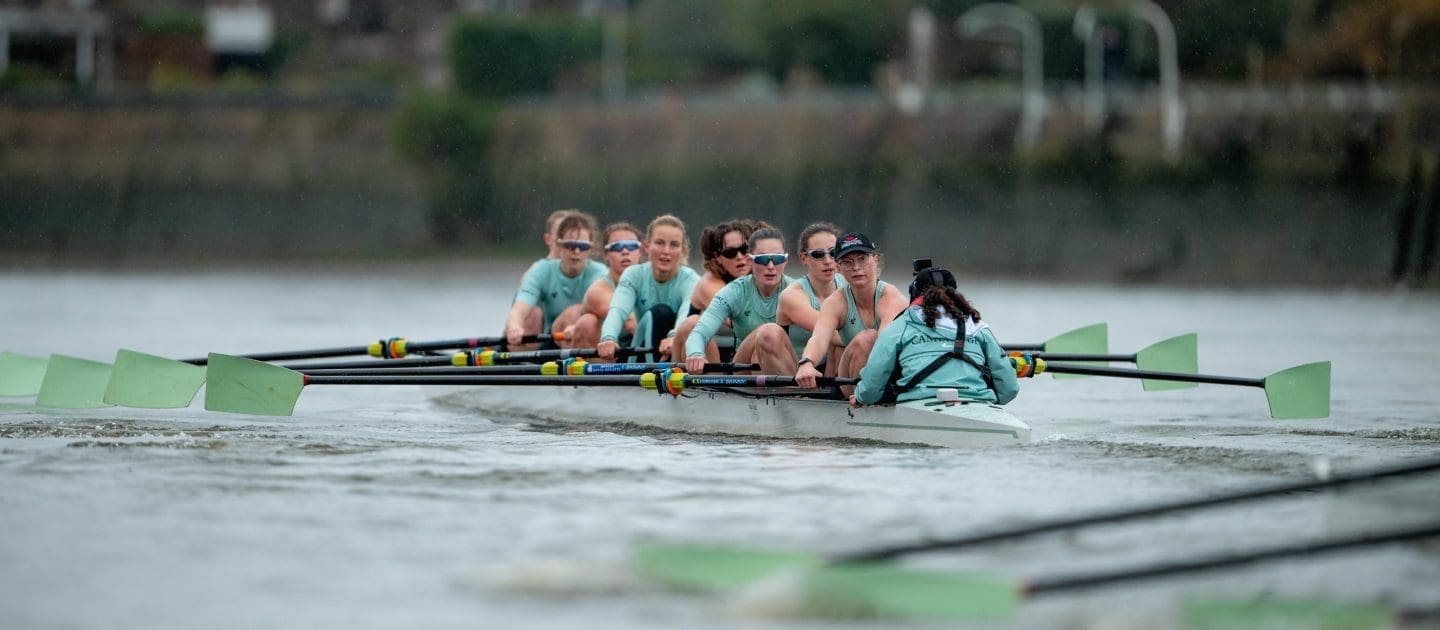
CUBC triallist Mathilda Kitzmann (pictured rowing in the four seat at Trial Eights) reflects on her rowing journey from Rostock to Cambridge via Stanford University.
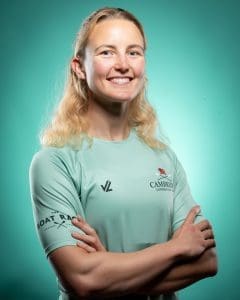 I learned about rowing when I was nine years old and already six feet tall.
I was shown the wooden oars, told why the seats roll, what port and starboard are (or strokeside and bowside), and why everything becomes inverted once you sit in the boat; facing away from the direction you are traveling, and your left becomes your right.
It was confusing, chaotic, and fascinating. I loved every part of being in a rowing boat.
Around the same time, my parents decided that we would spend Easter in London and it happened to coincide with the Boat Race. As a nine-year-old, I had a lot of questions. What is it called? What do you mean, just The Boat Race? How about all the other events in which boats race in this world? And it happens on the Thames, the big river in the middle of London?
My nine-year-old mind created an image of elite rowers and thousands of fans. The best of the best, people more experienced and adult than even my parents or any other respectable adults I knew. Probably better even than the athletes I had seen on TV at the Olympics.
“It was easily the most exciting thing that had happened in the first decade of my life.“
That first experience of The Boat Race gave me goosebumps. I was impressed by the noise made by the breathtakingly large audience, the view of the fast-moving, untameable river, and the sheer speed all the boats moved along. And somehow, nine-year-old me was right there. It was easily the most exciting thing that had happened in the first decade of my life.
Then we went home.
I continued rowing a few times a week, then every day as a teenager, and eventually competed on an international level as an Under 19 athlete. This was important because it opened the door for me to study in the United States, at Stanford University.
The US is a remarkable place for collegiate athletics, where top-tier education and elite sport coexist. In 2021, my first year, we placed second at the National Collegiate Athletic Association Championships (NCAAs), which was an enormous achievement for me, the team, and the program. Unlike the Boat Race, where second means you lose, this was simply one place away from coming first.
“The spectacle was still there, but now it felt closer.”
That year, we watched The Boat Race together, cheering on recent Stanford alumnae. This re-ignited the spark I had felt nearly ten years prior. The spectacle was still there, but now it felt closer. Knowing that women and men had taken the same path I was on made the race feel tangible in a way it never had before.
When I was at Stanford I spent a lot of time trying to understand the dichotomy of rowing. Rowing is hard, and bringing together all the complex parts of the movement seems like a Sisyphean task, yet it can be explained with simple physics. Success comes down to fine motor skills; tiny details such as placing the blade a fraction of a second too early, imperceptible by most, but interrupting the run of the boat and slowing it ever so slightly, stroke after stroke.
“I loved the rowing, but I did not want the rower to be all that I am. “
There was another contradiction to it too: rowing was something I devoted most of my time to, yet I resisted letting it become everything I was. Even as a student-athlete, to those around me I was often just ‘the rower’. And layered on top of all of it was a quiet imposter syndrome, racing among the best, while still feeling like it was just… me?
That was the second decade of my life. The second act of my rowing story was a mix of thinking about identity and individuality. I loved the rowing, but I did not want the rower to be all that I am.
During my years at Stanford, the idea of applying to Cambridge slowly took shape. The possibility of earning a seat in The Boat Race gave me something to work towards after graduation. It kept me going as I began to understand what it truly means to be a rower. This continued to unfold since starting my master’s degree at Cambridge in October 2025.
I have also realized that being seen as a rower is not a burden but a compliment. It means being grouped with high-achieving, relentlessly-working women, and that perspective softened my imposter syndrome. In the end, there is nothing to do but give your best and train among those who push you higher, because without playing up, you do not get better.
“All my thoughts about what it means to be a rower ultimately lead to The Boat Race.”
All my thoughts about what it means to be a rower ultimately lead to The Boat Race. Of course, there is the ambition of earning a seat and giving everything to make it to the start line, but just as importantly, there is the deeper desire to be part of the process itself. To train, to trial, to belong to CUBC, and to be close to a race that has been a dream long before it became a goal.
“I now know the fabulous athletes competing, and they are not superhumans but students”
I am in the third decade of my life now and the third decade of knowing about The Boat Race. Over time, I have gotten closer and closer to the event that I had put on a pedestal since I was nine years old. I now know the fabulous athletes competing, and they are not superhumans but students showing up for competition and for whatever rowing means in their personal lives.
Rowing has opened the world to me, bringing me across continents and into international education.
I am a rower, and I embrace training for The Boat Race with everything I have. But it does not mean it is everything I am.