
Words: Helena Smalman-Smith, with thanks to Mark Taylor for excerpts from his article in Cambridge News.
10 years ago, Cambridge lost the Women’s Boat Race.
But they won the respect of everyone who witnessed their astonishing comeback from being hull-down in some of the roughest conditions ever. Despite finishing 24 lengths down on a superb Oxford crew, they showed such determination and courage that it was their photos that were splashed (sic) across the front pages of national newspapers the next day.
Here’s what happened.
For the first seven or so minutes, this was an excellent, if entirely normal race. Cambridge, on Middlesex, had a slightly better start, but Oxford soon settled into a stronger rhythm. Shortly after Hammersmith Bridge, the Dark Blues, who were the pre-race favourites, had almost stretched their lead out to clear water. The river wasn’t flat, but the Championship Course was very rowable.
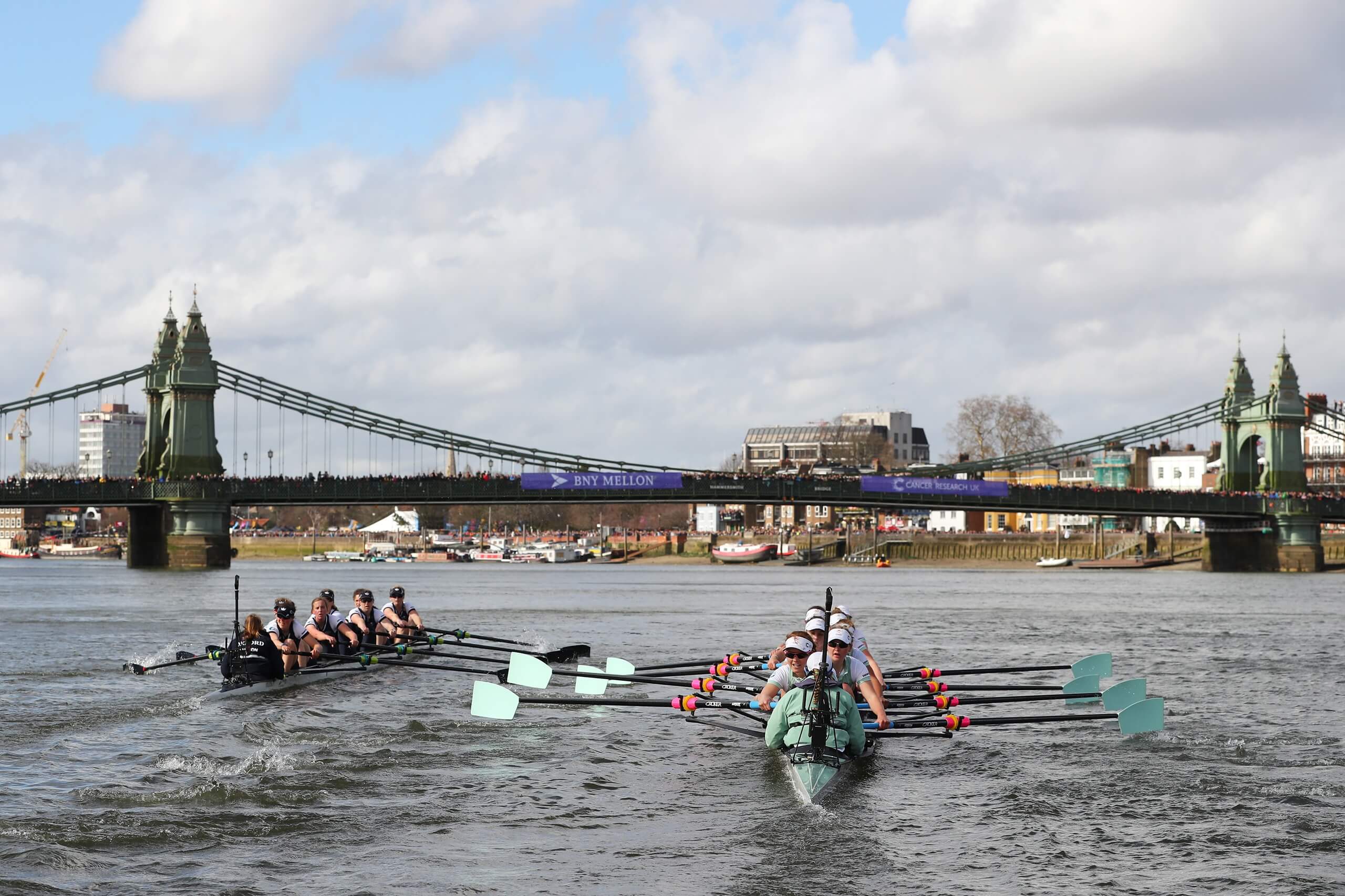
Approaching Hammersmith Bridge in fine racing conditions, the crews are still overlapped.
That changed dramatically as the crews turned southwest round the big Hammersmith bend and into a vicious headwind. Cambridge – out in the middle of the river – got the worst of the white horses that by now were galloping down the river towards the racing crews. Waves started breaking through their riggers, knocking the hull off balance one way or the other almost every stroke, and dumping ice-cold water onto the rowers and into the boat. Ashton Brown at bow got the worst of it; days later she would be diagnosed with aspirational pneumonia from inhaling dirty water and an A&E doctor asked her if she’d had a near-drowning experience.
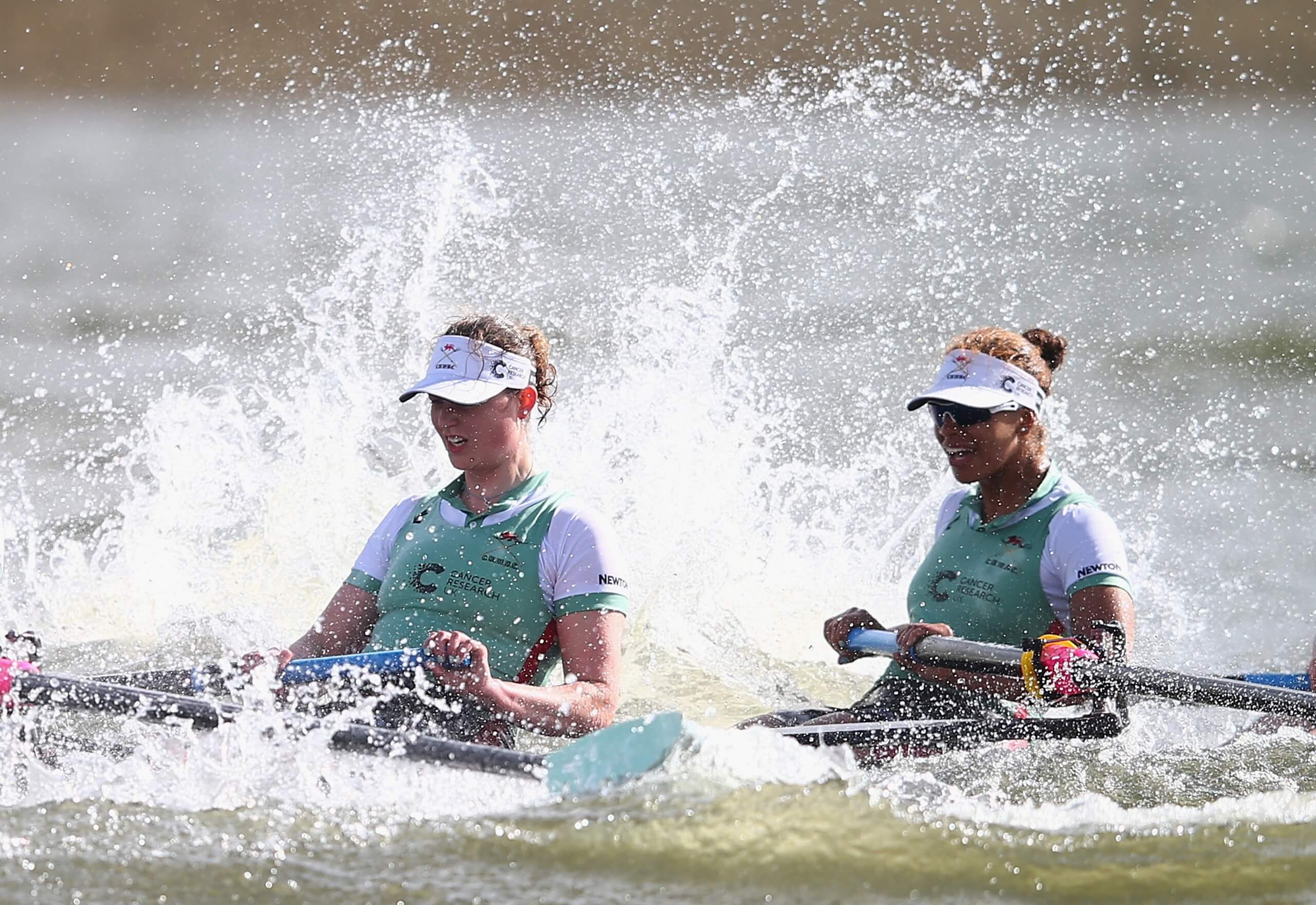
Myriam Goudet (left) and Daphne Martschenko.
By Chiswick Pier, Oxford were three or four lengths clear. Cox Morgan Baynham-Williams made the most of this and headed for the shelter Middlesex bank close under the Bandstand. She was out of the stream but she gambled that escaping the maelstrom was far more important.
Cambridge cox Rosemary Ostfield could have followed her but didn’t. In what she described as “maybe taking a crazy roll of the dice”, she stayed out in the faster stream.
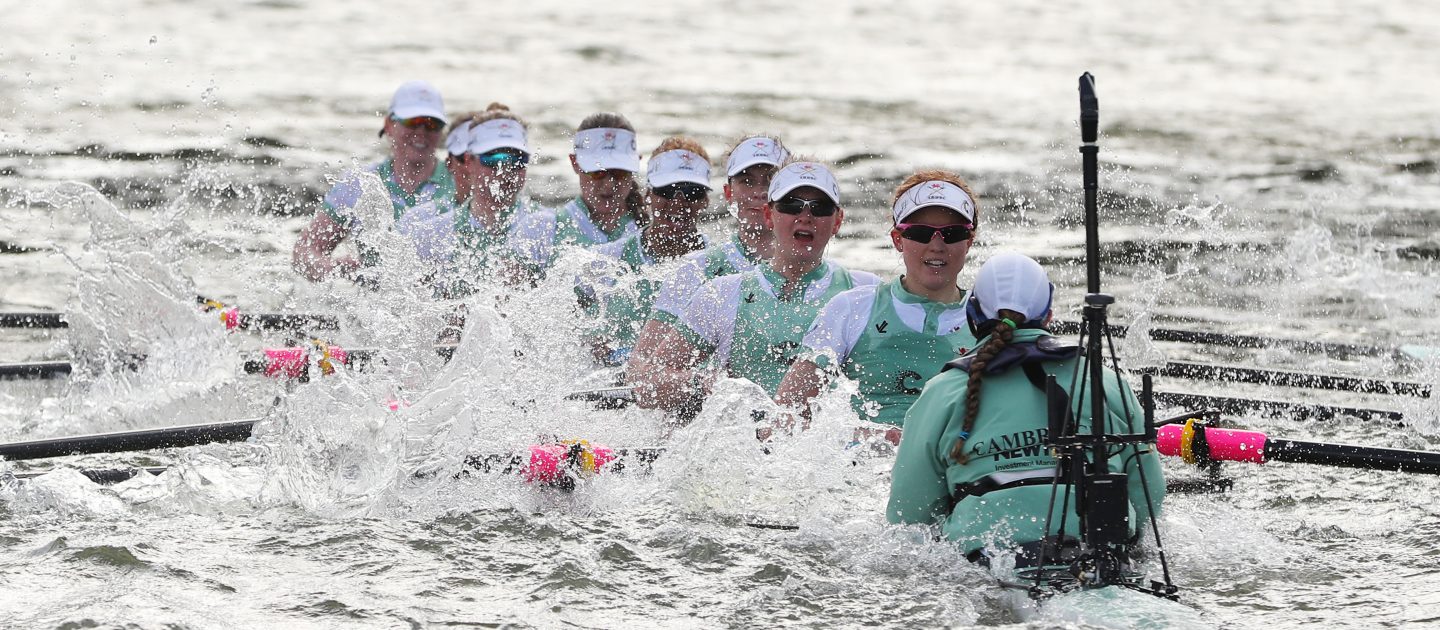
For a few strokes, the Light Blues’ bows started to creep back. But soon Cambridge were taking on water faster than the on-board electric pumps could expel it. Commentator Zoe de Toledo said, “There is a good chance that this Cambridge boat will not make it to the finish line.” With the hull sitting lower and lower, the waves were flooding in ever more easily, and the blades no longer had the clearance they needed to get off the water between strokes. It seemed there was little chance they’d even reach Barnes Bridge, never mind the finish, before they swamped completely.
And so it was. As they passed under Barnes, the whole hull sank disappeared out of sight.

Fully swamped under Barnes Bridge.
Yet the eight blades kept moving. And that’s what saved them.
Umpire Rob Clegg shouted, “Cox, put your hand up if you want to keep going,” and without hesitation, that’s what Ostfield did. As she steered towards the bank and marginally better water, the pumps got the edge and the sides of the boat emerged from the waves again – enough to give the crew and everyone watching hope. By the finish, they were almost rowing normally.
“When we were sinking, we didn’t think about anything,” said Myriam Goudet, who rowed at six. “We just carried on because it was the only thing we could do.” It was teamwork at its best, but every team needs a leader and two-seat Fiona Macklin was in no doubt that Ostfield was instrumental that day. “As athletes we kept rowing, but she was definitely the one who held us all together and took us to the finish line.”
“We had to keep going,” Ostfield said later. So many foolish naysayers didn’t want the women on the Tideway. In some ways, it was almost a mixed blessing it happened because it helped prove that of course women could do it. We were able to overcome a worst-case scenario.”
Despite their triumph over adversity, this was the Cambridge’s women’s 13th loss in 16 years. Since then, they haven’t lost a Boat Race, so perhaps the Light Blues took more on board that day than a boat-full of water.
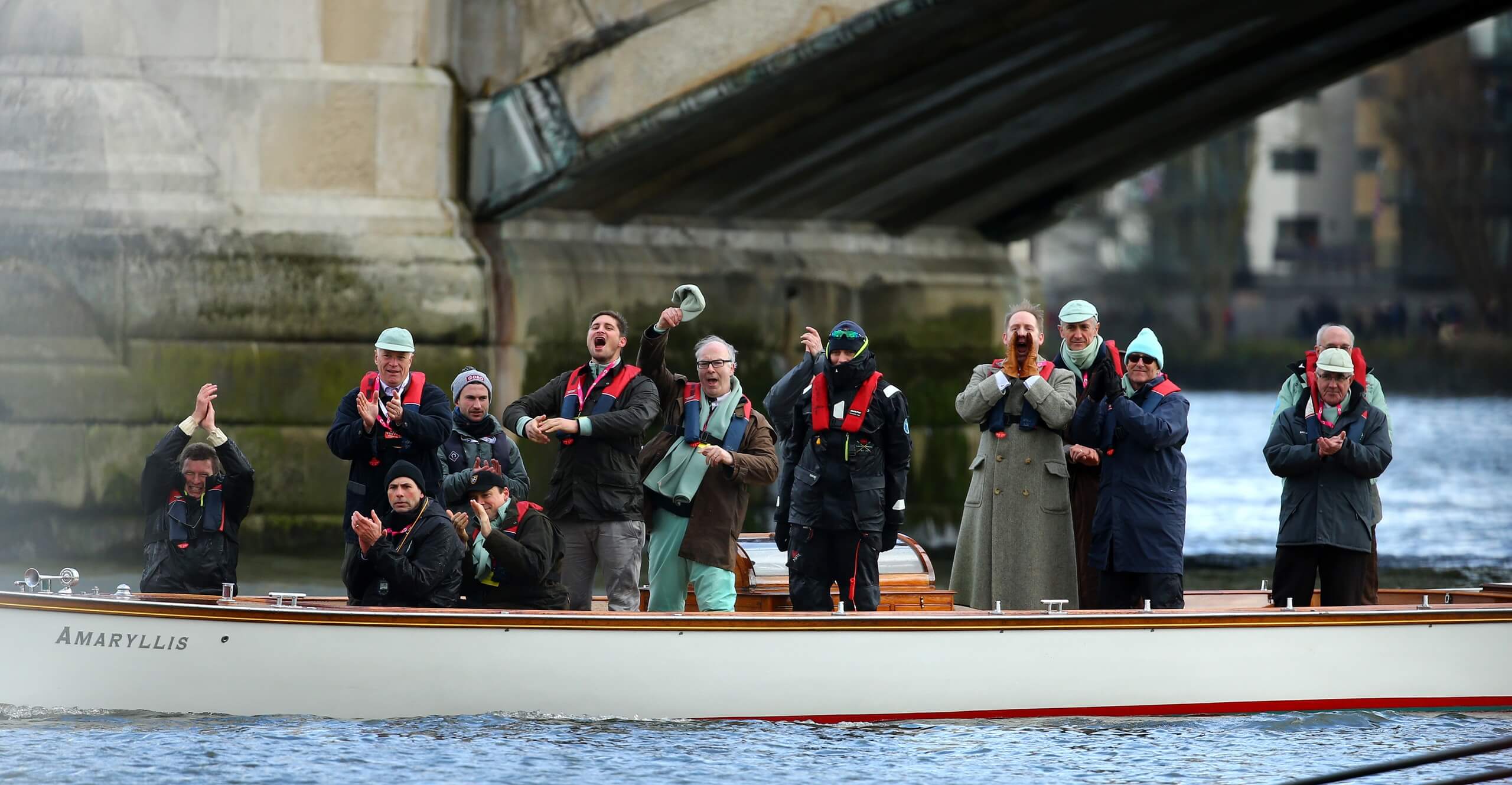
CUBC supporters applaud the crew’s extraordinarily courageous performance.
Photos: Getty Images.